
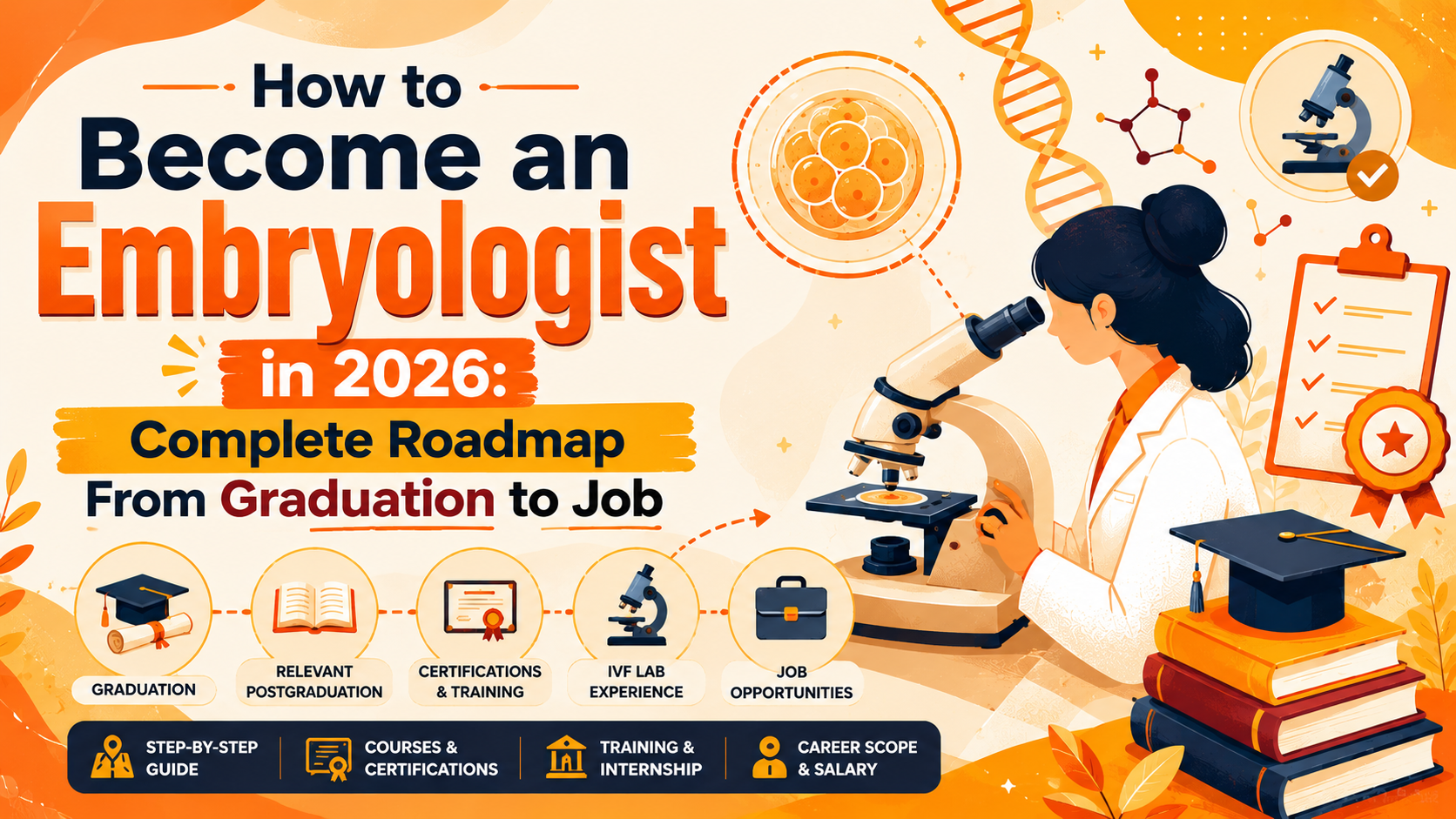
Are you fascinated by the miracle of life and aspire to contribute to reproductive science? The journey to become an embryologist in 2026 is rewarding, offering a vital role in fertility treatments. This specialized medical laboratory profession involves handling human eggs, sperm, and embryos. It requires precise scientific knowledge and meticulous laboratory skills to help individuals and couples achieve their dream of parenthood.
READ MORE: How to Become an Occupational Therapist in India 2026
Step-by-Step Guide to Become an Embryologist in India
To become an embryologist in 2026, candidates typically begin with a strong science foundation and progress through specialized training. The path involves specific academic qualifications, practical experience, and often professional certification. Aspiring embryologists must adhere to a structured educational and training roadmap to succeed in this demanding field.
| Step | Description | Key Action |
|---|---|---|
| 1 | Bachelor’s Degree | Complete a BSc in Biotechnology, Zoology, Microbiology, or a related life science field. |
| 2 | Master’s Degree | Pursue an MSc in Clinical Embryology, Reproductive Medicine, or Assisted Reproductive Technology (ART). |
| 3 | Clinical Training/Internship | Gain hands-on experience through a mandatory internship or structured training program in an IVF clinic. |
| 4 | Certification | Obtain professional certification, such as from ESHRE or ACE, to validate expertise and become an embryologist in 2026. |
| 5 | Job Application | Apply for entry-level embryologist positions in fertility clinics or research institutions. |
Educational Qualification Required for Embryologist
A strong academic background in biological sciences is crucial to become an embryologist in 2026. Typically, a postgraduate degree in clinical embryology or a related field is the minimum requirement for entry into this specialized profession. Eligibility criteria often include specific undergraduate degrees, ensuring a solid scientific base.
| Degree Level | Required Qualification | Typical Duration | Key Focus Areas |
|---|---|---|---|
| Undergraduate | BSc in Biotechnology, Zoology, Microbiology, Genetics, Biochemistry, Life Sciences | 3 Years | Biology, Chemistry, Cell Biology, Molecular Biology |
| Postgraduate | MSc in Clinical Embryology, Reproductive Medicine, Assisted Reproductive Technology (ART) | 2 Years | Andrology, Embryo Culture, Cryopreservation, IVF Techniques |
| Optional Higher | PhD in Reproductive Biology, Clinical Embryology | 3-5 Years | Advanced Research, Academic Positions, Specialized Roles |
Can I Become an Embryologist Without NEET?
Yes, you can absolutely become an embryologist in 2026 without appearing for the NEET exam. NEET is primarily for undergraduate medical courses like MBBS and BDS, which are clinical doctor roles. Embryology falls under paramedical and life sciences, focusing on laboratory work rather than direct patient diagnosis or treatment. Therefore, NEET is not a prerequisite.
READ MORE: How to Become a Speech Therapist in India 2026: BASLP, Salary, Eligibility & Career Scope
- NEET is not required: The National Eligibility cum Entrance Test (NEET) is exclusively for admission to undergraduate medical and dental programs in India.
- Focus on Science Degrees: Aspiring embryologists need a BSc in life sciences followed by an MSc in Clinical Embryology or ART.
- Alternative Entrance Exams: Universities offering MSc Clinical Embryology often conduct their own entrance exams or admit based on merit.
Myth vs Fact: NEET Is Mandatory to Become an Embryologist
It is a common misconception that NEET is mandatory to become an embryologist in 2026, but this is incorrect. The National Eligibility cum Entrance Test (NEET) specifically screens candidates for undergraduate medical and dental degrees, not for paramedical or laboratory-based scientific roles. Embryology education follows a different academic pathway, focusing on postgraduate science degrees.
READ MORE: How to Become a Nutritionist in India 2026: Eligibility, Salary, Courses & Career Scope
Clinical Embryologist Certification Requirements
Certification is crucial to validate expertise and helps individuals become an embryologist in 2026 with recognized credentials. Professional bodies offer certifications that demonstrate competency in various aspects of Assisted Reproductive Technology (ART). These certifications often require specific educational backgrounds, practical experience, and successful completion of a rigorous examination process.
| Certification Body | Key Requirements | Validity | Benefits |
|---|---|---|---|
| ESHRE (European Society of Human Reproduction and Embryology) | MSc in Embryology/related field, minimum 2 years ART lab experience, ESHRE exam pass | 5 Years | International recognition, enhanced career prospects, adherence to European standards. |
| ACE (Academy of Clinical Embryologists, India) | MSc Clinical Embryology, minimum 1-year supervised training/experience in an IVF lab, ACE exam pass | Lifetime (with renewal) | National recognition in India, professional credibility, networking opportunities. |
| ASRM (American Society for Reproductive Medicine) | Specific educational and experience criteria depending on the certification track (e.g., Embryology Laboratory Director) | Varies | US-based recognition, leadership roles, compliance with American standards. |
ESHRE Embryologist Exam Eligibility
Eligibility for the ESHRE Embryologist Certification Exam requires specific academic qualifications and practical experience. Candidates must hold a relevant university degree, typically an MSc in Clinical Embryology or a related science field. Furthermore, a minimum of two years of full-time work experience in an Assisted Reproductive Technology (ART) laboratory is mandatory to become an embryologist in 2026 with this international credential.
| Eligibility Criteria | Details | Proof Required |
|---|---|---|
| Academic Qualification | Master’s degree (MSc) in Clinical Embryology, Reproductive Biology, or a related life science field. | Degree Certificate, Transcripts |
| Clinical Experience | Minimum 2 years of full-time practical experience in a human ART laboratory. | Work Certificates, Letter from Head of Lab |
| Supervisor’s Endorsement | Recommendation from a certified senior embryologist or lab director. | Signed Endorsement Letter |
| ESHRE Membership | Current ESHRE membership is typically required to apply for the exam. | Membership ID |
IVF Embryologist Training Program in India
India offers several reputable IVF embryologist training programs, which are essential for those looking to become an embryologist in 2026. These programs typically range from short-term workshops to extensive postgraduate diplomas or master’s degrees. They provide crucial hands-on experience and theoretical knowledge in assisted reproductive technologies, preparing candidates for real-world lab environments.
| Program Name | Institution(s) | Duration | Focus Areas |
|---|---|---|---|
| MSc Clinical Embryology | Manipal University, SRM Institute of Science and Technology | 2 Years | Advanced embryology, ART techniques, research methodology |
| Postgraduate Diploma in Clinical Embryology | Craft Hospital & Research Centre, Kerala; various private institutes | 1 Year | Practical lab skills, cryopreservation, IVF, ICSI, quality control |
| Certificate Courses/Workshops | Numerous private IVF centers (e.g., IIRFT, New Delhi) | Weeks to Months | Specific techniques like vitrification, micromanipulation, culture media prep |
| Fellowship in ART | Reputable IVF clinics with academic affiliations | 6-12 Months | Intensive hands-on training, clinical case studies, advanced lab management |
What Is the Total Cost of Becoming an Embryologist?
The total cost to become an embryologist in 2026 varies significantly based on the chosen educational path and institution. Expenses include tuition fees for undergraduate and postgraduate degrees, certification exam fees, and potential living costs during training. For instance, an MSc in Clinical Embryology in India can range from INR 2.5 lakhs to 10 lakhs, excluding living expenses.
| Cost Category | Estimated Range (INR) | Details |
|---|---|---|
| BSc Degree (3 Years) | 90,000 – 3,00,000 | Tuition for Biotechnology, Zoology, or Life Sciences. |
| MSc Clinical Embryology (2 Years) | 2,50,000 – 10,00,000 | Tuition fees for specialized postgraduate programs. |
| Certification Exam (e.g., ESHRE, ACE) | 20,000 – 70,000 | Fees for professional competency exams, varying by body. |
| Training/Internship Fees (if applicable) | 50,000 – 2,00,000 | Some private clinics charge for structured training programs. |
| Living Expenses (2-5 Years) | 2,40,000 – 6,00,000+ | Accommodation, food, transport during studies/training (varies by city). |
| Total Estimated Cost | 6,50,000 – 21,70,000+ | Overall investment to become an embryologist in 2026. |
Embryologist Career Scope in India 2026
The career scope to become an embryologist in 2026 in India is robust and growing, driven by increasing infertility rates and advancements in Assisted Reproductive Technology (ART). According to the Indian Society of Assisted Reproduction (ISAR), the ART market in India is expanding at a significant pace. This creates a high demand for skilled embryologists in various clinical and research settings across the country.
| Career Opportunity | Description | Typical Work Setting |
|---|---|---|
| Junior Embryologist | Assisting in routine lab procedures, media preparation, basic cryopreservation. | IVF Clinics, Fertility Centers |
| Senior Embryologist | Performing advanced procedures like ICSI, embryo biopsy, managing lab protocols. | IVF Clinics, Large Fertility Hospitals |
| IVF Lab Director | Overseeing all lab operations, quality control, staff management, regulatory compliance. | Major Fertility Hospitals, Research Institutions |
| Research Embryologist | Conducting studies on embryo development, cryobiology, novel ART techniques. | Academic Institutions, Pharmaceutical Companies |
| Trainer/Educator | Teaching and training aspiring embryologists, developing educational programs. | Universities, Training Institutes, ART Academies |
Should I Choose Embryology or Genetics?
The choice between embryology and genetics depends on your specific interests within the life sciences. Both fields are vital in healthcare, but they focus on different aspects. Embryology centers on early human development and assisted reproduction, while genetics investigates heredity, genes, and genetic disorders. To become an embryologist in 2026 means focusing on fertility treatments.
| Feature | Embryology | Genetics |
|---|---|---|
| Primary Focus | Assisted Reproductive Technology (ART), embryo development, fertility treatments. | Study of genes, heredity, genetic disorders, personalized medicine. |
| Work Environment | IVF clinics, fertility laboratories, ART centers. | Research labs, hospitals (genetic counseling, diagnostics), biotech companies. |
| Patient Interaction | Indirect (via gametes/embryos), communication with clinicians. | Direct (genetic counseling), lab analysis for diagnosis. |
| Key Techniques | IVF, ICSI, embryo culture, cryopreservation, micromanipulation. | DNA sequencing, PCR, karyotyping, gene editing. |
| Career Outcome | Clinical embryologist, lab director, research embryologist. | Geneticist, genetic counselor, research scientist, bioinformatician. |
Will AI and Automation Replace Embryologists in IVF Labs?
While AI and automation are rapidly advancing, they are unlikely to fully replace embryologists in IVF labs. Instead, these technologies will augment and enhance an embryologist’s capabilities. AI can assist with tasks like embryo grading and selection, which can improve efficiency and consistency. However, the nuanced decision-making, manual dexterity, and ethical considerations require human expertise to become an embryologist in 2026 effectively.
- Myth: AI will completely take over embryo assessment and manipulation.
- Reality: AI can offer objective embryo grading, improving consistency and reducing inter-observer variability, but human oversight remains critical.
- Myth: Robotic systems will perform all micromanipulation tasks.
- Reality: Robots can assist with repetitive tasks, yet complex procedures like ICSI still demand the precision and adaptability of a skilled human embryologist.
- Myth: All lab tasks will be fully automated, eliminating the need for staff.
- Reality: Automation will streamline workflows, but human embryologists will focus on critical decision-making, quality control, and advanced troubleshooting.
How a BSc Biotechnology Student Became an IVF Embryologist
Many successful IVF embryologists began their careers with a Bachelor of Science (BSc) in Biotechnology. This foundational degree provides a strong understanding of molecular biology, cell culture, and genetic manipulation, which are highly relevant to reproductive science. After completing their BSc, these students pursue specialized Master’s degrees in Clinical Embryology. This pathway is a common route to become an embryologist in 2026.
| Year | Milestone | Description |
|---|---|---|
| Year 1-3 | BSc Biotechnology | Completed undergraduate studies, gaining knowledge in cell biology, genetics, microbiology. |
| Year 4-5 | MSc Clinical Embryology | Specialized postgraduate education, focusing on ART, cryopreservation, and embryology lab techniques. |
| Year 6 | Internship/Training | Undertook a supervised clinical internship in an active IVF laboratory, gaining practical experience. |
| Year 7 | Certification & Job Search | Obtained professional certification (e.g., ACE or ESHRE) and secured a position as a Junior Embryologist. |
Myth vs Fact: IVF Laboratories Hire Only Experienced Candidates
It is a myth that IVF laboratories only hire experienced candidates, especially for entry-level positions. While experience is certainly valued, many clinics are willing to hire fresh MSc Clinical Embryology graduates. They often provide extensive in-house training and mentorship. This approach allows new professionals to gain essential hands-on skills and become an embryologist in 2026 through structured learning programs.
Is an MSc Enough, or Is a PhD Beneficial?
An MSc in Clinical Embryology is generally sufficient to become an embryologist in 2026 and secure a clinical position. However, pursuing a PhD offers distinct advantages, particularly for those interested in research, academic roles, or leadership positions within larger institutions. A PhD provides advanced research skills and a deeper understanding of reproductive biology, opening doors to more specialized opportunities.
| Aspect | MSc in Clinical Embryology | PhD in Reproductive Biology/Embryology |
|---|---|---|
| Career Goal | Clinical embryologist, lab technician, junior research associate. | Research scientist, academic professor, lab director, R&D specialist. |
| Job Prospects | Good entry-level and mid-level positions in IVF clinics. | Highly competitive, often leads to senior roles, academic research. |
| Salary Potential | Solid starting salary with gradual increases based on experience. | Higher earning potential, especially in research and leadership. |
| Time Commitment | 2 years (after BSc). | 3-5 years (after MSc). |
| Focus | Practical skills, clinical protocols, routine ART procedures. | In-depth research, hypothesis testing, novel technique development. |
What Interview Questions Are Commonly Asked in IVF Clinics?
Interview questions in IVF clinics aim to assess both technical knowledge and soft skills necessary to become an embryologist in 2026. Employers look for candidates who understand ART principles, can handle pressure, and possess strong ethical judgment. Questions often cover laboratory protocols, quality control, troubleshooting, and patient confidentiality, ensuring a well-rounded candidate.
| Question Category | Example Questions | What Interviewers Look For |
|---|---|---|
| Technical Knowledge | “Explain the steps of ICSI.” “What is vitrification?” | Understanding of ART procedures, scientific principles. |
| Problem-Solving | “How would you troubleshoot a pH imbalance in media?” | Analytical thinking, ability to identify and resolve lab issues. |
| Quality Control | “Describe QC measures for an IVF lab.” | Awareness of lab standards, attention to detail, regulatory compliance. |
| Ethics & Communication | “How do you handle sensitive patient information?” | Professionalism, ethical conduct, teamwork abilities. |
| Motivation & Fit | “Why do you want to become an embryologist in 2026?” | Passion for the field, commitment, understanding of the role. |
Which Mistakes Cause Candidates to Fail Interviews?
Several common mistakes can lead candidates to fail embryologist interviews, even those qualified to become an embryologist in 2026. A lack of specific technical knowledge, demonstrating poor attention to detail, or inability to articulate problem-solving approaches are major red flags. Additionally, exhibiting a weak understanding of ethical considerations or showing a lack of genuine passion for the field can hinder success.
- Lack of Specific Knowledge: Vague answers regarding ART protocols, equipment, or quality control.
- Poor Communication: Inability to clearly explain technical concepts or previous experiences.
- Ignoring Ethics: Failure to discuss patient confidentiality or ethical dilemmas appropriately.
- No Critical Thinking: Unable to provide logical solutions to hypothetical lab scenarios.
- Lack of Preparation: Not researching the clinic, its services, or recent advancements in embryology.
Mistakes That Can Delay Your Embryology Career
Aspiring embryologists can inadvertently delay their career progression by making certain avoidable mistakes. Neglecting to gain practical laboratory experience during or immediately after their master’s degree is a common pitfall. Failing to pursue relevant professional certifications can also limit job opportunities. Additionally, not networking within the ART community can isolate individuals, making it harder to become an embryologist in 2026 quickly.
- Not Prioritizing Practical Training: Relying solely on theoretical knowledge without seeking hands-on lab experience.
- Delaying Certification: Postponing essential professional certifications like ESHRE or ACE, which are often employer requirements.
- Limited Networking: Failing to connect with professionals in the ART field, missing out on mentorship and job leads.
- Poor Resume/CV: Submitting a resume that doesn’t highlight relevant skills, internships, or academic projects specific to embryology.
- Lack of Continuous Learning: Not staying updated with the latest advancements in reproductive technologies and research.
Conclusion
The path to become an embryologist in 2026 is challenging but deeply rewarding, combining advanced science with the profound impact of helping create families. It requires dedication to continuous learning, meticulous technical skills, and strong ethical principles. With the right education and training, you can embark on a vital career in reproductive medicine.